
THE FUTURE OF THE OFFICE

Working in a post-pandemic world is going to look and feel different.

Sure, we can expect more flexibility in our schedules – a couple days at home, a couple in the office. And perhaps a new office layout with more space, collaboration areas and amenities.

For their part, companies nationwide are still defining what the post-pandemic workplace will look like.

“The more flexible and adaptable we can make a space, the more future-proof that can be for whatever … the next pandemic, for climate change, the next cultural trend,” said Johnna Keller, director of sustainability at M+A Architects.

“The more we can make the built environment flexible and adaptable and resilient, the less we are putting that on the occupant and the person.”

Everyone from landlords and company executives to architects and developers are considering the future of the office, and there is no shortage of opinions on what we can expect if and when we return to “normal.”

Jonathan Moody, president and CEO of architecture firm Moody Nolan, said companies that have a hard time defining their culture will have a hard time explaining to employees why they should return to the office.

“Literally, the places that we create are the true drivers of the culture,” Moody said. “And that needs to ripple through the street-level experience, the office experience, the residential experience.”

Mixed-use trending

Brad DeHays, founder of Connect Realty, said he has little desire to develop large office buildings anymore. He said mixed-use spaces that include residential units make more sense.

“We need to lead with housing if we want office,” DeHays said.

A trend he sees continuing is building new Class A office space while converting Class B office buildings into multifamily or mixed-use spaces.

So does Jeff Edwards, CEO and president of Edwards Cos.

Edwards is converting about half of the 360,000-square-foot PNC Plaza building on East Broad Street downtown into residential use with some ground-floor office and retail space. The other half of the building will remain offices.

The renovation will include replacing the dark glass atrium on the ground floor with a below-grade garden connected to a restaurant.

Edwards said new office space must be interesting – inside and out – and in both urban and suburban settings.

“Building a standalone office building isn’t going to cut it anymore,” he said.

Steven Schoeny, city manager in Upper Arlington, said because many local municipalities depend on income tax revenue, mixed-use developments with office space are highly valued.

“People want walkable developments,” Schoeny said. “Not all office is created equal. Standalone, single-use office is at more of a risk than something more amenity-rich, where you can do more than just work.”

DeHays said the landscape downtown is shifting, too.

“We’re five to seven years from seeing downtown Columbus look significantly different, but those decisions that get us there are going to be made in the next 12 to 24 months,” he said.

DeHays said Intel’s recently announced plans to build factories in New Albany “breathed life” into Central Ohio and will push big changes especially in the residential market.

Edwards said many of Intel’s projected 3,000 employees might want to live in downtown Columbus and commute to the New Albany campus.

‘A blank canvas’

Although many workers in Central Ohio have yet to return to offices downtown, Columbus Development Director Michael Stevens said he is “cautiously optimistic” that they soon will.

“Employers are all trying to balance hybrid work,” he said. “We’ll still see the office, but it might take up a smaller footprint.”

Stevens said new development projects such as The Peninsula and Astor Park will do well because they offer new Class A office space in a mixed-use setting.

The Peninsula includes apartments and a hotel alongside a speculative office buidling from Daimler Group.

Daimler CEO Bob White Jr. called The Peninsula “a blank canvas” for office tenants seeking to start fresh coming out of the pandemic, especially given the flight to quality seen in today’s market.

Edwards said his own various companies had been toying with flexible work and remote work before the pandemic.

“Not everybody wants to be working from home, but everybody wants flexibility,” he said.

Safe and comfortable

Architects and interior designers say they are working to find ways to make the office environment safe and adaptable.

Karen Dwyer, director of design at Meyers and Associates, said the return to office represents a lifestyle shift, similar to the one we made when we were sent home to work.

“This is going to stay in place for quite a while,” Dwyer said. “Giving people options is just really the name of the game. It’s going to be really critical for retaining employees, as well as getting new employees.”

Tamra Fuscaldo, director of interior design at M+A, said many designers are looking at giving workers more room, more hybrid work stations and multi-use spaces.

“Designs … are actually changing to accommodate more of the bigger amenity spaces,” Fuscaldo said. “There’s a reason to come in versus just coming in to use the space. You’re collaborating more. You’re doing your heads-down work at home and coming in for a purpose.”

Dwyer said Meyers and Associates has been designing office spaces that allow for downtime or to give employees a change of scenery.

“The home office has been a huge surge, because it’s been a necessity, but also people … could embrace certain things that are comfortable for them,” she said. “And some of that has to translate back into the workplace.

“I think as much as we design spaces to be more residential or hospitality-like, we’re doing the same thing with an office,” Dwyer said. “We want to make them comfortable, we want to make them adaptable.”

She said employers will have to listen to their employees more.

“It’s not one-size-fits-all anymore,” Dwyer said.

‘We space’

Michael Copella, market leader and managing director for CBRE’s Columbus operations, also sees the market changing and adapting.

He said the future of work includes a great remote work strategy, great real estate and great human relations.

“Your technology, your values, your culture – those things really matter when you’re designing your space,” Copella said.

Many CBRE clients have said that the pandemic has solidified why having an office is important to them, Copella said. The office is key not just for business transactions, he said, but also for keeping company culture alive.

“We are hearing now more from our clients that say … ‘This has reinforced why we believe in office,’” Copella said. “It might not necessarily be the same footprint, but they’ve said now it’s kind of crystallized what the purpose of the office is.”

CBRE recently completed a study that found that the office of the future will need more “we space” – space that can be used for individual work or a gathering.

Currently only 13% of space in most offices operates as “we space.”

“We really feel that while the longer the pandemic has has gone on, it’s probably putting more stress on office, but we also feel like the best parts of the office have become more important,” Copella said.

“This idea of having the office be a space to bring people together, to have that ‘we space,’ to have it be like the physical beacon of the company’s culture and values is now more important than ever.”

Reevaluating space

At the same time, companies are trying to figure out whether they need the same amount of space that they had before the pandemic.

Sublease availability doubled from 2019 to 2021 as companies tried to right-size. In the Columbus market, there were 95 available spaces for sublease in January, representing about 1.2 million square feet, according to a Colliers report.

Matt Gregory, senior vice president with NAI Ohio Equities, said smaller, more creative sublease spaces are snatched up quickly.

Some 82% of available sublease space is less than 20,000 square feet.

Growing tech firm Upstart leased 240,000 square feet of Alliance Data’s space in Easton for seven years. And Alliance Data still has other sublease space available.

Jason Hogan, vice president of real estate and facilities services at Alliance Data, said the pandemic accelerated the company’s plans to allow more employees to work from home and consolidate its real estate.

As for the space that the company is keeping, Hogan said it is changing, too.

Alliance Data added bleacher seating for employees doing educational work, quiet pods for heads-down work and created more community spaces so employees can “bounce around,” depending on what kind of work they’re doing at the time.

“The real estate we kept, we wanted to make it encourage hybrid work, so we retooled and redesigned that space,” Hogan said. “We know that people come in and want to do different kinds of work. So we created different kinds of spaces that enable those kinds of work.”

American Electric Power Co. also is subleasing some space in its portfolio. AEP has subleased 12,000 square feet at its Rich Street location and has vacated about 65,000 square feet at 825 Tech Center Dr., according to CoStar.

Therace Risch, chief information and technology officer for the utility company, said although AEP reopened offices in November, the ensuing rise in Covid cases sent many of them home again.

“This is a learning period,” she said.

Risch said because there is a bigger push for collaborative spaces in AEP offices, the company is looking into removing cubicles and improving technology in conference spaces.

In April 2020, Columbus-based insurance giant Nationwide said it would be closing many of its smaller regional hubs, including offices in Gainesville, Florida; Harleysville, Pennsylvania; Raleigh, North Carolina; Wausau, Wisconsin; and Richmond, Virginia.

And Nationwide recently sold its office complex in San Antonio, Texas, with plans to lease back some of its square footage inside.

Nationwide also put about 300,000 square feet in the Arena District and Grandview Yard up for sublease, according to CoStar.

Vinita Clements, chief human relations officer at Nationwide, said the company also is considering more open floor plans and has a rotating schedule for employees to come into the office so that safe distances can be maintained.

The insurance giant has announced a new permanent hybrid work policy.

Before, about 18% of Nationwide employees worked from home.

Now about half do.

Nationwide continually surveys employees to learn about how they want to work and what they hope to gain from work.

That effort led to the creation of a “future of work” online education series that offers employees virtual classes to learn new skills.

Clements said Nationwide views its facilities as an extension of the company’s culture.

“We are the culture,” Clements said.

Much as it has solidified for companies why having an office of some sort is important, the pandemic has helped companies realize why their people are important – even if they don’t see them every day.
Ten development projects that could shape Columbus for decades to come

The pandemic has not stopped development in Greater Columbus, but it continues to shape the construction landscape, positively and negatively.

For warehouse and residential construction, the pandemic has proven a boon. For retail, offices, not so much, although work continues on those fronts as well.

In 2021, the Columbus area saw $5.9 billion in new construction (through November), up 26% from the previous year, according to Dodge Data & Analytics.

Looking ahead, here are 10 development projects underway in 2022 that are poised to shape Columbus for decades to come:

The Peninsula, East Franklinton

What’s going on: The first part of The Peninsula development on the west side of the Scioto River is expected to open this summer, tilting Downtown a bit to the west. This year, one office building, two apartment buildings and two parking garages are scheduled to open, followed by a hotel and a 34-story apartment-office-and-parking tower. When completed, the 26-acre development could include up to 20 buildings with 2 million square feet of offices, 1,800 residences, 200,000 square feet of retail space and 400 hotel rooms. A few blocks west, on Broad Street, the first part of the 840,000-square-foot mixed-use Gravity 2 development is also expected to open, further adding activity to the East Franklinton neighborhood.

What to watch: The big question for The Peninsula and Gravity projects is whether they succeed at the expense of the historic core of Downtown. While it’s far too early to tell, at least one office tenant has committed to moving from Capital Square into The Peninsula. Will others follow?

North Market Tower, Downtown

What’s going on: Work is expected to begin this year on the $300-million tower on the parking lot next to the historic North Market on the north end of Downtown. When completed – it’s forecast for 2024 – the development will include 171 apartments, 212 hotel rooms, 57,000 square feet of offices and 353 parking spaces in a complex that includes a 31-story tower, a 20-story portion and a nine-story section.

What to watch: The development, coupled with the 28-story Hilton expansion being built across North High Street, will go a long way to filling the remaining gap between The Arena District and The Short North. Will it also be the boost to the market itself that leaders hope?

The Trolley District, Franklin Park

What’s going on: The first two bars opened in this entertainment district at the tail end of 2021, but 2022 will be the year this long-awaited destination starts to really take shape. Eight years in the making, the $25-million district is built from the shell of the city’s trolley car facilities from the 1880s. The first part of the district to open, the East Market food and retail hall, will include 11 vendors and two bars when fully open this spring. In addition, the Columbus Brewing Co. plans to open its brewpub and beer garden within the next few months, followed by several other restaurants in another of the five buildings that make up the Trolley District.

What to watch: The Trolley District fills a void of bars and restaurants in the Franklin Park neighborhood, but is also the fifth of seven planned food halls in the Columbus area, raising questions about the depth of the audience for such venues.

New Albany growth

What’s going on: The past few years have seen an explosion of growth in the New Albany area that is likely to take big steps forward in 2022. In addition to the ubiquitous Georgian-style homes, the city is adding major warehousesdata centers, office complexes, medical offices, apartments and retail developments to create a full work-live-play community. Expect to see some developments that got started in the past few years, including in the Hamilton Quarter area, to be fleshed out this year, along with a new plant for the biotech firm Amgen.

What to watch: On Tuesday, the city of New Albany voted to annex up to 3,190 acres into the city from Jersey Township for an expansion of the New Albany International Business Park. Look for an announcement on what the site will house.

Ohio State University

What’s going on: A casual drive down Rt. 315 around OSU’s campus reveals a sea of cranes that is transforming the campus. West of the highway, development is focused on the university’s “Innovation District,” poised to ultimately include 4 to 6 million square feet of laboratory and commercial office space, up to 500,000 square feet of medical space, 1,500 to 2,000 residences, 100,000 to 200,000 square feet of retail space, and a 180- to 220-bed hotel. On the other side of the highway, work continues on the $1.8-billion, 26-story addition to the Wexner Medical Center.

What to watch: Ohio State’s projects have the potential to change far more than the skyline. Both the hospital expansion and, especially, the Innovation District, could propel job growth for decades to come. The Innovation District alone is forecast to create 12,000 jobs over the next 25 years.

Astor Park, Arena District

What’s going on: Last year’s new home of the Columbus Crew, Lower.com Field, is only the first of many projects planned on the western edge of the Arena District. Work has begun on a 15-acre development called Astor Park, next to the stadium, which will include a five-story office building, a 750-space parking garage and two apartment buildings with about 440 apartments. In addition, the Arena District’s developer, Nationwide Realty Investors, is looking to develop two large sites near the stadium.

What to watch: Astor Park benefits from a beautiful, dynamic and updated riverfront setting, but will its tricky access dampen tenant interest?

Upper Arlington

What’s going on: Work is well underway on two developments that will impact Upper Arlington for decades. On Lane Avenue, the 11-story Arlington Gateway development will bring offices and apartments to the former site of Darron’s Contemporary Furniture and Half Price Books. On the opposite side of Lane, the first tenants are expected to open this year in the second phase of the Westmont at The Lane development. Several blocks north, work is also well underway on the redevelopment of the Kingsdale Shopping Center, with new buildings containing 458 apartments, 104 senior housing units, restaurant and parking space and a community center.

What to watch: The city of Upper Arlington is expected to announce details next month for its long-awaited $55-million community center, the city’s first.

Capital Square, Downtown

What’s going on: The past two years have dealt a heavy blow to Downtown. The pandemic emptied offices and protests boarded up buildings. Still, investors are placing bets on the rebound of Capital Square offices, including the Fifth Third Center, which is getting a $24-million facelift. But the two most intriguing developments Downtown are moves away from offices: Work is underway converting much of the PNC Bank tower on East Broad Street from offices to residences, and the Continental Centre high-rise on East Gay Street is expected to follow suit.

What to watch: Will other investors follow PNC’s and Continental’s leads and convert largely empty Downtown office buildings into housing?

Industrial boom

What’s going on: A banner year in warehouse construction, fueled by pandemic shopping from home, shows no sign of stopping in 2022. A record 9 million square feet of new warehouses were built in the Columbus area last year, and another 15 million are under construction, according to the commercial real-estate firm Cushman & Wakefield. Meanwhile, vacancies in existing spaces fell to an almost non-existent 2.6%. From West Jefferson to New Albany to Etna, enormous distribution centers have risen, or are underway, while the area around Rickenbacker International Airport remained the industry’s Greater Columbus hub.

What to watch: Will this year finally see the redevelopment of the Columbus Castings site on the South Side? Stonemont Financial Group of Atlanta bought the 74-acre property in August, but so far has remained mum about plans.

Nationwide Children’s Hospital

What’s going on: The seemingly never-ending development around Nationwide Children’s Hospital won’t end in 2022. In addition to the Interstate-70 redesign, work continues on the hospital campus itself along East Livingston and Parsons avenues, with a new parking garage and expansion of the Ronald McDonald House.  Although most of the work isn’t expected to start this year, the hospital unveiled a $3.3-billion expansion plan that will include a 12-story inpatient tower, an orthopedic and surgery center, and two new research centers.


Retail’s Past And Future In Columbus, Ohio

In 1909 the Lazarus Department Store opened in the center of Columbus, a city-block-sized temple to commerce. By the time it closed in 2003, traffic had dwindled as an American institution, the downtown department store, was supplanted by mushrooming malls.

In 1989, huge crowds flocked to the opening of Columbus City Center, a concrete, 1,250,000 sq ft, three-level shopping center that was famous as central Ohio’s largest and most upscale shopping mall. Within a decade, it was dying. By the time the structure closed in 2009, only a few fast food storefronts occupied the vast, mostly empty space. The downtown behemoth, close to the Ohio Statehouse and the Ohio Theatre, attracted vandals and gangs. Late in the sad mall’s life, someone was even murdered there.

“Newer malls had been erected in the suburbs, closer to shoppers’ homes.

There was no reason to drive into Columbus to go shopping, so City Center declined and stood empty,” says Amy Taylor of the Columbus Downtown Development Corporation, a private, non-profit development corporation founded in 2002 to implement the Downtown Strategic Plan.

“The City Center Mall failed because downtown Columbus did not have the population to support it,” says Michael B. Coleman. Mayor of the City of Columbus from 2000 to 2016, he is the longest-serving mayor in the city’s history, as well as its first African-American mayor. Today he works in private law practice and is chairman of the board of the Columbus Downtown Development Corporation.

“Retail happens when people live in an area, not the other way around,” he says.

“When I was first elected, I made bringing more residents into the center of the city it a priority. After a whole lot of discussion and exploration, we knew that, to grow the downtown, the mall had to go.”

The decision did not go down well with locals.

“I would ask people who objected to razing the mall when they had last gone there, and it was usually years ago,” Mayor Coleman says. “But they had sentimental attachment to a place where they bought something special once upon a time.”

Coleman was attacked and vilified; he was literally cursed and spat upon.

“Fortunately, taking down the mall had to proceed slowly because it stood atop five underground parking garages,” Amy Taylor explains. “Between 2009 and 2011, people had a chance to watch it being dismantled, and by the time they saw what took its place, they were ready.”

Today, what was the Brutalist City Center is Columbus Commons, a nine-acre, $25 million project that produced a green park anchored by a stage at one end, a carousel at the other. Food trucks gather during the workday; weekends bring concerts, outdoor movies, fireworks displays and other festivities.  Bordering the park, on the site of former parking lots, are Highpoint at Columbus Commons, two brick and limestone seven-story buildings that represent a $50 million investment on the part of CDDC; they bring 983 new one- and two-bedroom apartments.

Next door, the aptly named Lazarus Building has a new life, its 700,000 square feet transformed into offices, all of which are occupied.

“It was given to the CDDC,” Taylor explains. “We did a green renovation that installed a seven-story light well, built a 1/3-acre green roof, harvested rainwater and utilized wheat board instead of drywall.”

When Michael Coleman took office in 2000, downtown had fewer than 3,500 residents, a mere 10% of the all-time high of 30,000 residents in 1950. Today, the population is expected to reach 12,000 by the end of the year. According to the 2020 census, Columbus has a total population of 905,748. It is the 14th most populous city in the U.S. and the third-most populous state capital.

“Columbus is home to Ohio State, and used to be a brain drain city,” Coleman says. “Students would graduate and leave for Chicago or other places. Now Columbus is a brain gain city, as many Ohio State students decide to stay and live here after graduation.”

Housing figures largely in new Columbus development: Astor Park, the new neighborhood being developed around  Lower.comField, the stadium for the Columbus Crew, the city’s professional soccer team, includes two striking architect-designed residential buildings, as well as office and commercial space.

As Coleman predicted, new residential development brings all manner of retail. Perhaps the most ambitious is the Trolley District created by Brad DeHays, whose Connect Real Estate and Connect Construction is developing 20 historic properties in downtown Columbus. Among them is the city’s former Industrial Light and Power Station, which will open as chic office space in spring of 2022.

DeHays is turning Columbus’ enormous 1880s Trolley Barn into a market building.

“The Near East Side of Columbus is currently deemed a food desert due to its lack of proximity to grocery stores and food resources,” DeHays says. “The Trolley District will open with over 18 local food vendors. It is the largest collective of only locally owned businesses in central Ohio. Neighbors in the community are target customers for local produce, daily consumables and food-oriented programming at the East Market. The East Market will provide prepared foods and beverages such as coffee and pizza, and also unprepared foods such as vegetables, butchered meats and fish.”

Smaller adjacent buildings — former foundries, coach facilities and machine shops that serviced the trolleys — will be occupied by a local craft brewery, restaurants, a gym, a test kitchen and co-working space. Key to the project: a 102-unit apartment building.

To finance the Trolley District, DeHays used two allocations of new market tax credits, two state historic tax credit awards and federal historic tax credit, as well as loan assistance from local banks and foundations.  He also sought and received a 30-year Downtown Redevelopment District designation to provide needed ongoing capital expenditure dollars to keep the market running for 30 years.

“It was a grouping of federal, state and local incentives to provide a sustainable development for long term growth and stability of the neighborhood’s newest community resource,” he says.

In other words, the Trolley District aims to become everything City Center and the Lazarus Department Store were not.

Downtown Columbus population tops 10,000, but will it continue to rise if workers stay home?

Downtown Columbus’ population more than doubled over the past decade, hitting and surpassing the 10,000 mark, according to 2020 population figures recently released by the U.S. Census Bureau .

The question now is whether the number of residents Downtown will continue to increase at a similar rate over the next 10 years, as many office workers continue to work from home and others worry about safety.

Some believe it will.

“I don’t think it is that much of a wild card,” said Marc Conte, acting executive director of the Capital Crossroads and Discovery special improvement districts Downtown. “People still want to live in an urban environment. People want an urban lifestyle.”

Within Downtown’s traditional boundaries, the population grew from 5,226 in 2010 to 10,342 in 2020. Those boundaries roughly follow Interstate 670 to the north, Interstate 71 to the east, Interstates 70 and 71 to the south, and the section of the Scioto Peninsula east of the CSX railroad tracks and Route 315 to the west.

The population slipped slightly in one eastern Downtown census tract bounded generally by Grant Avenue to the west, Broad Street to the north, Interstate 71 to the east and Interstates 70 and 71 to the south, from 1,261 to 1,253.

Conte said there are currently 15 projects with 1,300 housing units under construction Downtown. He said that with the housing shortage across central Ohio, those units will be in demand.

“I think those units will fill up,” he said.

Those projects include a couple by the Edwards Companies: the conversion, already underway, of 14 floors of the PNC Plaza building at 155 E. Broad St. into 120 residences and a 13-story, 133-unit apartment building at 195 E. Broad St.

Conte said he believes the conversion of office buildings into residential space will continue. Buildings that have small floor plates lend themselves to residential conversion, he said.

“If you look at what’s been built in the Short North, the floor plates are just as small,” he said.

Also in the pipeline Downtown: a six-story, 145-unit apartment building now under construction at Grant Avenue and Oak Street by the Pizzuti Companies. And the Columbus Downtown Development Corporation plans to build a $20-million, 93-unit affordable apartment complex at East Town Street and South Washington Avenue near Topiary Park.

The development corporation is focusing on creating more affordable housing options Downtown after Guy Worley stepped down in May under pressure from Mayor Andrew J. Ginther, a board shakeup and the appointments of Amy Taylor as president and Greg Davies as CEO.

Taylor said she remains bullish on Downtown’s growth because of the amenities it has, including parks such as the Scioto Mile and Topiary Park. “There is a capacity to grow from what we’ve seen,” she said. The downtown development corporation is overseeing the development of 26 acres just west of COSI on the Scioto Peninsula across from Downtown, including 1,800 residences.

In 2002, former Mayor Michael B. Coleman set a goal of 10,000 Downtown residents by 2012. The city created tax incentives to boost Downtown residential projects that still remain.

Downtown’s population peaked at 29.845 in 1950, said Michael Wilkos, senior vice president of community impact at the United Way of Central Ohio who has studied population data and demographic changes in the Columbus area.

Wilkos said he believes the trend in Columbus and across the country will be for continuing residential demand in downtown areas because empty nesters and young people like the lifestyle and conveniences such as restaurants and entertainment.

“Lots of people work somewhere else but live Downtown,” he said.

Even Youngstown — where the population dipped 10%, to just more than 60,000, between 2010 and 2020 — saw a growth in population in the downtown area, he said. Population in the census tract that includes downtown Youngstown grew by 15%, from 3,052 to 3,506.

Brad DeHays, founder of Connect Realty, is developing four projects with 150 units Downtown, which are either already under construction or in the planning phase.

“I think for the next 12 months we’re going to see momentum pick up,” said DeHays, who said the COVID-19 pandemic and last year’s protests did wound Downtown. “There still are a significant number of projects in the pipeline. I see a majority of those projects getting built. They’re some of the most unique products in central Ohio.”

Tony Lococo, president of the Downtown Residents Association of Columbus, said he doesn’t see Downtown residential growth slowing because of the demand for urban living, and believes office workers will be back in two years.

“People want to live in an urban atmosphere,” Lococo said.

People such as Emma Mulvaney. She has lived Downtown for about three years, moving there so she could be close to Capital University Law School. She rented first, but eventually bought a condominium.

Mulvaney is a lawyer and her law firm is Downtown, but she has been working from home. Yet she likes the flexibility of walking to work when she must go in.

“Convenience plays into staying Downtown,” said Mulvaney, 26, as she walked her two dogs down Gay Street earlier this week. So do easy access to restaurants and places such as Pins Mechanical, she said, a bar that features duckpin bowling.

Rob Vogt, managing partner of Vogt Strategic Insights, a Columbus-based real-estate research firm, agrees that he believes people will feel comfortable returning to the office once the COVID-19 pandemic is behind us. That said, he still expects Downtown to see moderate residential growth.

“We’ve got such a housing shortage,” Vogt said of Columbus.


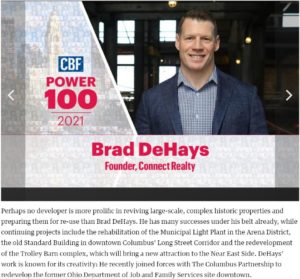
The 2021 Power 100: See the full list of the most-influential people in Central Ohio

In what is now an annual tradition, Columbus Business First is identifying the 100 people making the most impact on Central Ohio during a time of tremendous upheaval as we emerge from the Covid-19 pandemic.

It is never an easy task and this year was no different.

This is the third edition of the Power 100 and many prominent community and business leaders have made the list each year. You’ll see in the write ups in the attached gallery, however, that no one has remained on the list by virtue of their positions. They have been actively shaping the Columbus region through their business leadership and community involvement.

And that leadership has never been needed more. The schisms exposed by the pandemic’s upheaval are stark reminders that we have a long way to go to become a thriving community where everyone has the opportunity to take part in the progress.

One area in particular that has taken on heightened importance for many companies is their diversity, equity and inclusion initiatives – a renewed emphasis mirrored throughout the community. We made some changes to the Power 100 lineup for 2021 to include some of the people driving that conversation.

You’ll also find many talented business leaders who are helping the economy thrive, which we obviously need to make solutions more achievable.

We should not forget that while the Columbus region faces many challenges, we remain the beacon of progress for the rest of Ohio. That’s due largely to our expanding economy, which is creating jobs for newcomers moving here

The leaders we’re highlighting also are building on the work of generations of leaders before us who have built Central Ohio into a great place to live and work. We still have work to do to take advantage of the region’s strengths and fix its weaknesses, but the future is bright, thanks to the efforts of all 100 leaders included here.

What’s new in Columbus since COVID-19 locked us all down?

You’re ready to step out into this post-pandemic world, to visit restaurants, movie theaters and more.

So what changed in Columbus in the last year and a half?

Soon there will be a new Crew stadium in the Arena District. The first game in the $314 million stadium will be July 3 (Look for a special section in the Dispatch and on Dispatch.com about the stadium on July 2).

Read more: Crew stadium will open July 3 to a full crowd

Trolley Barn

On the Near East Side, the Trolley Barn is expected to open in August. It will feature familiar restaurants and new ones. Committed tenants include Columbus Brewing Co. and Local Cantina.

Read more: Trolley Barn to open on Near East Side.

Budd Dairy Food Hall

If you’re hungry and can’t wait until August for the Trolley Barn to open, there’s Budd Dairy Food Hall. It features a bunch of restaurants, from Comfort Kitchen to Cluck Norris.

Read more:Budd Dairy opens in Italian Village

Restaurant openings

Despite the pandemic, dozens of brave restaurant owners opened new businesses in the last year. There are many new eateries, including Urban Meyer’s new restaurant. And in the works is a Jackie O’s in Downtown Columbus.

Read more: New restaurants that opened during the pandemic

Library plaza gets facelift

The East Plaza of the main branch of the Columbus Metropolitan Library – near Topiary Park – is getting a redesign after library officials said the space isn’t being used.

Read more: Library wants to create outdoor event space

Columbus Partnership organization targets Downtown recovery

Among all of central Ohio’s commercial real estate transactions in March, the one for 145 S. Front St. might have raised the most eyebrows.

The 200,000-square-foot state office building, empty since 2007, was sold for $3 million.

Instead of a developer, the buyer was the Columbus Partnership, the private, nonprofit collection of the area’s most powerful corporations, which announced plans to turn the seven-story building into a mix of offices, retail space and residences.

The Partnership has been active in economic development since its founding in 2002, but until now, has stayed away from bricks-and-mortar.

The purchase signaled a more active role for the Partnership in Downtown development. The impression was heightened by the timing of the purchase — nearly simultaneous with changes at the Columbus Downtown Development Corp. that gave Partnership members seven of the 13 CDDC board positions.

Among the new CDDC members is the Partnership’s CEO, Alex Fischer.

Fischer pointed out that the Partnership always has been involved in Downtown development, but noted that Downtown is in a more precarious position than it was before the pandemic.

“I’ve always believed, and the Partnership has always believed, that one of the key assets to the entire region from an economic development standpoint is a healthy downtown,” Fischer said.

“I don’t know any cities in America that don’t have vibrant downtowns. You could argue that as goes Downtown, so goes the region.”

For Fischer, the past year simply made the focus on Downtown more urgent. The pandemic emptied many Downtown offices, followed by protests that boarded up much of the urban core. Office vacancies rose, restaurants closed and the rush into Downtown apartments stopped.

“I don’t think we can assume that post-COVID, Downtown stays on the same trajectory it was on,” Fischer said. “I think place-making will matter more than ever after COVID, and I put a higher priority on Downtown than I did a couple years ago.”

Downtown faces the immediate challenge of bringing workers, residents and restaurants back, but other long-term challenges remain, Fischer said.

“I think we recover from that fairly quickly,” he said. “Then the question becomes: What are we doing next? There’s so much opportunity around Capitol Square, Columbus State, Nationwide Children’s Hospital, the corridor along Grant (Avenue), and to the (Scioto) Peninsula and all of Franklinton.

“I think this is a moment of reassessment and engagement to define what the next phase of Downtown development is.”

Fischer sees the Partnership’s primary roles in Downtown development as helping set priorities, bringing parties together and providing a corporate perspective.

“We bring first-hand knowledge of what’s going on with employers,” he said. “We bring a lot of insight, strategy, specific expertise to the table.”

Real estate developer Jeff Edwards, CEO of the Edwards Cos. and a member of both the Partnership and the CDDC boards, said the Partnership can bring a lot to the discussion on Downtown, where his company has completed several significant projects and has plans for more.

“I’m not sure exactly how an expanded role will play out, but for the entire Partnership, there’s significant resources to make things happen,” he said. “Downtown was on a roll prior to COVID, and I think it has work to do going forward.

“In the short term, we need to just put the virus behind us and get people returning to work,” Edwards said. “In the long term, it’s still a challenge to bring people Downtown from the suburbs and on weekends, but you’ve got a real jump with 10,000 people living Downtown now.”

Michael Stevens, Columbus’ director of development, welcomed the Partnership’s attention on Downtown.

“We’re excited about their participation as we come out of the pandemic,” Stevens said. “The Partnership has been focused on economic development and recognizes that for successful regional economic development, we need to have a strong and vibrant downtown.”

The Partnership is focusing on Downtown during a transition time for the Downtown Development Corp., the private group that helped redevelop the Scioto Mile, John F. Wolfe Columbus Commons park, the National Veterans Memorial and Museum, the former Lazarus building and the River South District.

The organization is now spearheading the development of the Peninsula, the 26-acre patch immediately west of COSI in Franklinton that will include a dense mix of residences, offices and retail uses.

In March, the CDDC’s longtime CEO, Guy Worley, announced he is stepping down as the city revamped the board, in part to focus more on bringing affordable housing to Downtown.

Fischer, now on the CDDC board, said Worley’s replacement “has to first and foremost be collaborative and be able to walk between public and private interests and do it in a way that brings people together.”

He said he is eager to find a replacement for Worley, whose last day is May 31.

“I think we all share a healthy sense that we’ve got to proceed with a sense of urgency, not because there’s a problem but because there’s a lot of opportunity,” he said.

Fischer said the Partnership bought the state of Ohio-owned building because members feared it would continue to deteriorate and saw it as a key part of the block that also contains the Ohio Supreme Court building and the Partnership’s own offices.

The Partnership paid $3 million for the building, significantly below the value placed on it by two 2019 appraisals commissioned by the state, which estimated its value at $5.2 million and $6.2 million. The state’s Department of Administrative Services never sought bids for the building but instead sought legislative authority to sell it directly, as it has for other buildings.

Last summer, the legislature authorized the state to sell the building to the Partnership for $3 million.

“The purchase price was negotiated between the parties considering the extent of time the property sat vacant and the continuing deterioration of the condition of the building,” said DAS spokesperson Melissa Vince

Despite the investment, Fischer said he does not expect the Partnership to go into the development business.

“This isn’t our core business,” he said. “Never say never, but I view this very much as a one-off.”

The Partnership is working with Brad DeHays, founder of Connect Realty, to redevelop the building. The state had gutted the building before selling it, leaving it primed for renovation.

DeHays said he is working with the Cleveland architectural firm Sandvick, which specializes in historic renovations, on a plan that would convert the top three floors into 81 apartments, floors two and three into offices and the ground floor into retail, with parking below.

“It has a deep footprint, so we’ll need to add a light well in the middle,” DeHays said. “But the views are beautiful, and we’re excited about our preliminary designs.”

DeHays said the Partnership hopes to get the 1964 building onto the National Register of Historic Places, which also would help attract historic tax credits for the renovation.

DeHays said he is approaching the redevelopment much as he would any project, but having 70 of central Ohio’s most prominent CEOs as your boss does change things a bit.

“I don’t see this as significantly different, but there is an added emphasis of wanting to make sure they’re engaged,” he said. “They’re experienced; many are real-estate owners themselves. The level of creativity in this group is just amazing.”

New Columbus Crew beacon a tall order

As paint jobs go, the smokestack at the old Columbus Municipal Light Plant is a tall order – 250 feet straight up, not a thing to stand on.

When finished in a blaze of yellow and black, it will serve as maybe the most distinctive billboard in Major League Soccer.

But how to clean and paint a 25-story, 107-year-old tube? A scaffold was ruled out – too high and too square. A worker basket could be hung from a crane, but the slightest wind could send it swinging.

“Scaffolding around the stack just wasn’t feasible and hanging work baskets from a crane just wouldn’t have been stable,” said Brad Annan, who is managing the project for Municipal Light Plant owner Connect Realty, on behalf of the Columbus Crew, which is paying to transform the smokestack.

Trolley District near Franklin Park aims for August opening with food hall, brewpub

The Trolley District, a $25 million redevelopment of the city’s old trolley car facilities near Franklin Park, is on track to start opening in August.

The developer, Brad DeHays, wishes it had been a lot sooner.

“I would have liked to have opened a month ago,” said DeHays, owner of Connect Realty.

The project was delayed by construction challenges to the 1880s-era buildings, including a fire that damaged the roof and heavy rains that collapsed a wall soon after construction began last spring. Work continued through much of the COVID-19 pandemic until the fall, when outbreaks knocked out contractors.

“Every time a contractor got COVID, it shut them down,” DeHays said. “It wasn’t so bad last summer, but in the fall, I couldn’t go a week without a quarantined contractor.”

DeHays expects the first phase of the district, the East Market building, a food hall and bar that anchors the development, to open in August, followed in the fall by the Columbus Brewing Co. brewpub and beer garden.

Scheduled to open next year will be a small building housing a seafood boil restaurant; a small office building; and a larger building housing four more tenants including Local Cantina Mexican restaurant.

In all, the development will house about two dozen food, bar and retail tenants in five buildings on more than 3 acres. The project is so expansive that DeHays changed the name from the Trolley Barn project to the Trolley District.

“There’s so much going on here, I thought we needed another name,” DeHays said. “It’ll change this whole area.”

Ultimately, the District will also include the Trolley District Apartments, a five-story, 102-unit apartment building on the southeast corner of Oak Street and Kelton Avenue, across the street from the East Market building. DeHays plans to start on the apartments in the spring.

Aubrey Stevens, director of operations and leasing for the Trolley District’s East Market, said several tenants have signed on for the food hall including Butcher & Grocer, which will lease five of the market’s 23 stalls; Creole to Geaux restaurant; Fourteen Twenty Nine bakery; and vendors serving tacos, pizza, breakfast and Mediterranean dishes. She did not identify the restaurants because they have not all told their current landlords.

The eastern end of the East Market building will be occupied by the Railhouse bar, and tables for customers of the food vendors and open onto a large elevated patio. The building’s lower level will feature a small speakeasy-type bar called Switch and the upper level will include seating for almost 200.

Stevens said the market is looking for Chinese and Indian food vendors, a florist and an ice cream shop, among others, but overall, “I feel good about where we are.”

In its five stalls around the market’s entrance, Butcher & Grocer will sell fresh meat, cheeses, seafood, grocery items, and salads and sandwiches to go.

Butcher & Grocer owner Tony Tanner said he’s looking forward to opening on the East Side, following his success in Grandview Heights.

“I’m a lifelong East Sider,” Tanner said. “I still live on the East Side. A lot’s happening there. We saw this as an opportunity to get our foot in the door in that area.”

Tanner is hoping to be able to open by the end of August, but is facing delays getting equipment.

“Things that would normally take four to six weeks now are taking up to 16 weeks, and that may not change soon,” he said. “The lead times are incredible. Anything made of stainless steel is impossible to get now.”

Columbus Brewing Co. owner Eric Bean is shooting for a fall opening of the company’s brewpub, which occupies a 13,000-square-foot building on the site. The pub can seat 263 indoors and another 108 on the patio.

“We’re shooting for the fourth quarter, but it could be as early as September,” Bean said. “But with everything that’s happened over the last year, it’s hard to predict construction.”

DeHays certainly understands that. The five buildings that made up the Trolley Barn District were little more than brick shells when he acquired the property more than seven years ago. He has rebuilt the roofs, shored up the walls, dug a basement in the main building, poured floors, and installed electricity, plumbing, cable and heating and cooling. He’s dealt with a fire and a collapsed wall.

“It’s been an engineering feat to rebuild this,” said DeHays, who has financed the project with the help of tax incentives.

Despite the necessary updates, the Trolley District buildings remain unmistakably vintage, with their exposed brick, high ceilings and timber beams. DeHays has enhanced the effect by installing gas-fueled lights in the Railhouse bar and embedding train tracks in the concrete floors.

Bean has worked with DeHays for five years on the project and is also ready for it to open, but knew it wouldn’t be an easy one, especially with a pandemic.

“If we’d talked this time last year, you would have heard panic in my voice,” he said. “At this stage, I certainly wish the patio were open, but we’ve been working on this project for so, long, we’ll be ready when it’s ready.”

More vendors for Trolley Barn’s East Market slated to be announced this spring

While Trolley Barn’s East Market and Columbus Brewing Co. space is slated to open in July, we should hear more details about vendors by April, according to Connect Real Estate founder and owner Brad DeHays.

One of those vendors, Tony Tanner, who is slated to bring his butcher shop and restaurant to the space, said the market will serve as a resource for the community.

“It’s going to be a centerpiece of the east side,” said Tanner, who owns The Butcher & Grocer and Cleaver in Grandview.

Five as of yet unannounced tenants have committed to the East Market so far, and the space is about 60% leased, said Jeff Baur, senior vice president of development.

“We are excited to bring a fresh food market to a neighborhood that has been devoid of healthy food options for a long time,” Baur said.

The market and brewing space are part of a larger five-building complex, The Trolley District, DeHays said. Once known as the Columbus Electric Car Barn, the complex at 1600 Oak St. dates back to the 1880s.

The West Car Barn, the largest of the five buildings, will be turned into the East Market at Trolley District, DeHays said. The space will feature 19 stalls of private food users on the main floor, as well as an eatery and tavern called Railhouse. A second-floor event space will accommodate up to 300 people. The lower level will include cold storage and prep space for the vendors, as well as a small bar named Switch.

A second building, the Mechanic Shop, is leased out to Columbus Brewing Co., DeHays said. The 13,000 square-foot space will feature a restaurant, a taproom, and a private tasting area and will be slated for special, innovative brews.

A third building, the Brass Shop, is slated for a retail tenant that is unannounced as of yet, DeHays said.

All three buildings are expected to open by July, he said.

A fourth building, the Power Plant Building, is slated for office space, while a fifth building, the East Car Barn, could house commercial or hospitality tenants, DeHays said. The date for both buildings’ openings depend upon when tenants are identified, though the tentative timeline is November.

Connect Real Estate is also building 102 apartments across the street, to be known as the Trolley District Apartments, DeHays said. The project is anticipated to break ground earlier this year, and should be available for lease by June 2023.