
More people moving to Downtown Columbus despite Covid-19 as new apartments continue to rise

Downtown Columbus’ residential population is expected to reach 10,000 this year despite Covid-19 and an uncertain economy and office market.

The State of Downtown Columbus report by the Capital Crossroads and Discovery special improvement districts, unveiled during Wednesday’s Columbus Metropolitan Club forum, said that 9,855 people live Downtown, with an apartment occupancy rate of 85.7%. That was down from 94% the year before.

One reason: Six apartment buildings opened in Downtown Columbus, bringing the total number of housing units Downtown to 8,062. Another 1,169 units, a $128 million investment, are under construction, with an additional 1,591 units totaling $506 million proposed.

Brad DeHays, founder of Connect Realty and one of three panelists at the forum, said he believes there will continue to be demand for Downtown housing. He said the number of new projects in the works shows that developers remain bullish.

Downtown resident Timothy Crawford, assistant professor in the Department of Family Medicine and Public Health Sciences at the Boonshoft School of Medicine at Wright State University, said he had no problem selling his Downtown property last year, moving to another Downtown home.

“We got an offer the week we did it,” he said.

Still, the median sale price of owner-occupied units in 2020 was $316,500, down from $392,000 the year before.

Marc Conte, the acting executive director of the special improvement districts, said the Downtown protests that began in May over the death of George Floyd at the hands of  Minneapolis police caused some to rethink moving Downtown, where property owners dealt with millions of dollars in damages.

Conte said Downtown is still recovering from that. And he said the urban core’s locational advantage won’t recover until the pandemic subsides.

“Covid is a bump in the road, not a monumental shift,” he said.

DeHays said the popularity of Connect’s MicroLiving Lofts apartments at 260 S. 4th St. help prove the economic argument that there’s not enough affordable Downtown housing. The micro-units go for $809 to $929 a month, according to apartments.com.

“Every metropolitan area has the same issue,” he said. But once people move Downtown, attracted by restaurants and bars and other reasons, they find larger places to live nearby.

The Downtown residential population is expected to hit 10,100 this year, and projected to be 12,421 in 2023. In 2002, the population was 3,619.

By comparison, Downtown Cleveland’s population was 20,000 in 2020, while Cincinnati’s was 10,140 last year.

For the purposes of the report, Downtown Columbus’ boundaries are Interstate 670 to the north, Interstate 71 to the east, Interstate 70 to the south, and the CSX railroad tracks in East Franklinton to the west.

The report said 89,199 people worked Downtown as of 2018, the most recent numbers available.

Office market questions

As of last year, 19.2% of Downtown office space was not leased. That’s up from 14% in the fourth quarter of 2019.

The question is whether companies will return staffs full-time to Downtown, or if there will be some sort of hybrid as more decide to work from home at least part of the time, if not full-time.

DeHays said he believes companies will bring people back to the office. There could be hybrid workplaces, but companies need central locations, he said. One reason: to help recruit workers.

“It’s difficult to create a culture when you’re working from home,” DeHays said.

Now that people can work remotely from anywhere, he said local developers are seeing a trend of employers in expensive coastal cities looking at offices in places such as Columbus, where Ohio State University churns out new talent.

He said one thing that will help attract people back Downtown is taking the boards off buildings.

“We’ve had some people from out of town ask why the boards are still up,” he said. “Perception is reality. We know we have a safe environment Downtown.”

Bob Szuter, the co-founder and head of operations at Wolf’s Ridge Brewing, agreed.

“We never closed our business,” Szuter said. “We always felt it was important to stay open.This is our city. We are going to be here.”

Despite Covid-19 and economic uncertainties heading into 2021, there were still 32 projects under construction Downtown totaling $1 billion in investment. That includes Crew Stadium ($300 million), the Hilton 2.0 at the Greater Columbus Convention Center ($220 million) and the Scioto Peninsula mixed-use development just west of COSI ($272 million).

Another 36 projects totaling $1.5 billion have been proposed, including the Confluence Village project on West Nationwide Boulevard, the Gilbert, a 13-story, $44 million apartment building at the southeast corner of East Broad and Young streets, and Harmony Tower, a 30 story, $100 million residential and hotel tower proposed for a parking lot just north of the Atlas Apartments at North High and Long streets. That total also includes $761 million in construction on interstates 70 and 71 Downtown.
Columbus overhauling zoning code as city struggles with redevelopment issues

Few things roil Columbus neighborhoods more than proposed developments that residents feel don’t belong.

Typical objections: The projects are too big. They’ll generate too much traffic. They’ll clash with the style of the area. Often, the properties where developments are proposed need zoning changes, from variances to full-scale rezoning of the property from one designated use to another.

Since 1960, Columbus’ population has nearly doubled, now to about 900,000. Scores of new neighborhoods have been built since then. Some others have declined, but their location and the city’s lack of available housing has made them popular again and seeing new interest.

But the city hasn’t overhauled its zoning code since the 1950s.

“Columbus is not the place we were 20-30 years ago. We’re not going to be the same 20-30 years from now,” Mayor Andrew J. Ginther said. “We have to make sure the zoning code reflects that reality, reflects mixed-income neighborhoods.”

The city of Columbus is conducting an online survey at https://www.surveymonkey.com/r/98FT8H5 asking residents what they think the city’s priorities should be, from affordable housing to encouraging historic preservation to accommodating a growing population to promoting equity to creating walkable neighborhoods.

So far, about 1,500 people have taken the online survey. The initial deadline to participate is Feb. 28, but city officials say that will be extended.

The city has hired a consultant, Lisa Wise Consulting from San Luis Obispo, California, for $200,000, to help in the process.

City officials say the time to revamp the zoning code is long past due, prompted in no small part by the number of projects that need those changes and variances. Those often cause neighborhood uproars such as taller buildings that have angered residents in the Short North and recent proposals such as apartments at Oak and South 18th Street in Olde Towne East, and a Pizzuti apartment development at a Giant Eagle site near German Village.

“The key was our variances have exploded in numbers. Hundreds of variances,” said Anthony J. Celebrezze III, assistant director for the Department of Building and Zoning Services.

That was red flagged to the mayor, he said.

“We still are seeing heavy pressure throughout the city for residential units,” Celebrezze said. “Even with COVID we’re seeing pressure for multi-family residential in walkable neighborhoods.”

Jon Melchi, executive director of the Building Industry Association of Central Ohio, said that when so many projects need variances to go forward, it’s a strong signal that the code needs to be updated.

“It’s been more of a challenge lately to get projects done,” Melchi said.

“Time is ultimately money. Hopefully, this code will prove a little more clarity.”

One big question that looms: How to craft a code to accommodate dense urban neighborhoods as well as those suburban-style neighborhoods built in growing areas of Columbus after World War II?

It could be that the code could be changed to reflect that not all neighborhoods are the same. Doreen Uhas-Sauer, who leads the University Area Commission, said that maybe there should be one set of standards for neighborhoods built around the same time and within four miles of Downtown Columbus, and different standards for an area such as Clintonville, with its different setbacks and side yards.

“German Village is not that different than Victorian Village in how it approaches things,” she said.

Jeff Brown, a long-time local zoning attorney, said Columbus’ zoning code needs to be updated to reflect the inward development now happening in older neighborhoods.

“We have a very suburban-style zoning code,” Brown said. So in popular neighborhoods such as Italian Village, developers always end up needing variances, he said.

And the code reflects the era in which it was written, including manufacturing districts created during the smokestack era, Brown said. That means someone who wants to open a recycling facility needs a permit for a salvage yard.

Kathleen Bailey leads the Near East Area Commission, which covers an area of the city that has seen an explosive growth of redevelopment in recent years.

“The number of variances has increased now because we’re seeing a lot of development,” she said. “Those zoning codes don’t fit in the neighborhood.”

Carlie Boos, the executive director of the Affordable Housing Alliance of Central Ohio, said the city needs more affordable housing, but many neighborhoods are zoned in a way that prevents that.

“That creates artificial scarcity, drives up the pricing,” Boos said. “It means people who want to build affordable apartments can’t compete.”

And the current code doesn’t make things easier, she said.

“We’ve got this Frankenstein code, a hodgepodge of rules,” Boos said. “You have to get a variance for everything.”

So the code has to be redesigned to work for the next 20-30 years, she said. While the city’s population is as big as it’s ever been, some neighborhoods, such as Linden, had higher populations before than they do now.

“We’ve got the infrastructure. It’s about returning to that density. We’re prepared for that already,” Boos said.

Becky West, the executive director of the Columbus Landmarks Foundation, agreed that the zoning code needs an overhaul, and that she’s optimistic it will lead to more historic preservation.

“We can do better in Columbus,” West said.

“I think this is the city’s effort to pave the way for that,” she said. “We are a growing city and we are trying to accommodate that growth.”

Celebrezze said the city is just at the beginning stages of this process, which could take two years.

Ginther said the city will be looking at other zoning models around the country. Some cities have aggressively changed zoning codes, including Minneapolis, which in 2019 ended single-family zoning citywide, allowing duplexes and triplexes to be built on single-family lots. Sacramento City Council in California voted 8-0 on a draft plan that would eliminate single-family zoning, and the state of Oregon has passed a similar statewide law.

Asked about zoning codes that don’t have a single-family home designation, Ginther replied, “We’re not at that point in the process.”

Ginther said city officials will study codes in cities growing as quickly as Columbus and the lessons officials there learned. “I don’t think we have any one example or best practice,” he said.

While Columbus’ population continues to grow, annexation has slowed to next to nothing. The city annexed more than 53 square miles from 1961-1970, and 35.7 square miles in the 1970s.

Annexation dwindled to less than 10 square miles from 2001-2010, and just 2.8 square miles from 2011-2020. Columbus now encompasses about 225 square miles, Celebrezze said.

As a result, development, and redevelopment, will be within Columbus.

“The city is not likely to annex much more ground, at least in the near-term,” Melchi said. “You’re talking about infill and repurposing existing properties.”

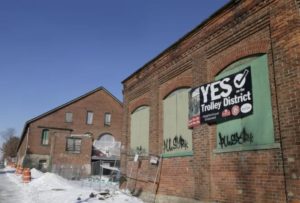
Columbus is doing a major overhaul of its zoning code for the first time in more than 60 years, in part due to multi-family development projects such as the conversion of the former trolley barn into apartments and commercial retail along Oak Street.

Hard Hat Tour: Trolley District Taking Shape Near Franklin Park

Workers are busy transforming the collection of historic buildings at the northeast corner of Oak Street and Kelton Avenue into a food and entertainment destination.

New floors and structural supports are in the process of being installed, ceilings are being repaired on buildings that have been open to the weather for decades, and bricks from buildings that once stood on the site have been unearthed, cleaned and used to fill large holes in the buildings that are still standing,

Work on the site – known for years as the Trolley Barn Complex – started in March, but the latest plans for the project were put in motion when the parcel was bought by developer Brad DeHays in 2014.

DeHays, whose Connect Realty has taken on several large historic renovation projects elsewhere in Columbus, recently gave Columbus Underground a tour of the development.

He said that if all goes according to plan, the complex will welcome its first visitors next June or July.

Now officially called the Trolley District, the centerpiece of the first phase of the project is East Market, a public market that will feature 20 stalls and a restaurant on its main floor. Downstairs will be coolers and storage space for vendors as well as a small bar, while the upstairs will hold an event space that will double as a seating area for market customers.

“It’s going to be the most unique event space in Central Ohio…11,000 square feet, with gridded glass skylights,” DeHays said, pointing out openings that will provide a visual connection between the main and upper floors, and allow lots of natural light into the building.

Tony Tanner, operator of the Butcher and Grocer in Grandview, has signed on to fill several of the stalls, and more tenant announcements are expected early next year.

The market will occupy the largest building on the site, known as the west car barn, which was used as a paint shop for trolley cars. A parking lot is being built to the north of the building, where a second car barn once stood.

DeHays said he is also excited about the Columbus Brewing Company’s plans the former mechanic’s shop building. The longtime brewer’s new taproom will feature a fireplace and a large bar, with space for several brewing tanks, and will spill out onto an outdoor beer garden.

Between the beer garden and Oak Street, a flex space is planned that will provide extra parking as needed and a route for deliveries to come through during the day, but can be transformed into an outdoor events area at other times.

DeHays said that the second phase of the project, which consists of several buildings on the east side of the site, will be completed some time next fall. That means the entire project will be complete by the end of November, a timeline that he expects to stick to, given the requirements of the Ohio Historic Preservation Tax Credits program (the project was awarded the credits in 2018).

“We started slow; with the pandemic, and then all the rains in April, we immediately got behind 90 days…we started digging and with all that water coming in, we had to change plans,” he said, referring to their approach to the market building’s foundation and basement. “With these tax credit deals, you have to figure out a way to plow forward, because you have a delivery timeline, and if you don’t deliver, there are huge repercussions.”

A five-story, 102-unit apartment complexis planned for the empty lot directly across Oak Street from the project. DeHays said that work on the apartments, which got zoning and neighborhood approvals at the same time as the other buildings, will start late next year.

Confidence remains strong for Downtown Columbus residential projects

Despite Covid-19, new apartments are being rented as they come online. Hotels are still struggling.

In 2014, Brad DeHays decided to take on a real estate project that no other developer had pursued over a span of 40 years. He saw the Columbus Municipal Light Plant, originally constructed in the late 1890s, as an opportunity for his real estate development group to expand its footprint in the hot downtown Columbus office market.

At the time, the three-building structure at the west end of Nationwide Boulevard had been vacant since the city of Columbus stopped operating the coal-burning power plant in 1977. Surely, the founder of Connect Real Estate thought, a renovated structure that preserved the building’s unique features would be a draw for creative companies that wanted to make bold statements about their brands.

It didn’t take long for DeHays to be proven right.

With renovation of a 1903 portion of the structure complete in 2019, Garth’s Auctioneers & Appraisers opened a 16,000-square-foot showroom in the building and Red Architecture & Design took 9,000 square feet for its office. In early 2020, work began to renovate an adjacent seven-story structure that will have 35,000 square feet of office space plus a parking structure.

Three months later, Covid-19 began washing across the country, prompting businesses to rapidly shift to remote work. Suddenly, Downtown Columbus became a ghost town. Not only did DeHays have new office space to lease, he also had a parking structure to fill.

“Major employers not being downtown puts a huge strain on retail, on hotels, but also on the parking assets Downtown,” DeHays says. “Until all the major employers return and business travel starts to pick up, that trend is going to continue.”

DeHays considers Connect Real Estate and its partners on the project, Schiff Capital Group and GBX Group, fortunate, though. While they’re not rolling in parking dough, they have leased 23,000 square feet in the building that will open in the late spring.

“We are comfortable in leasing and maintaining smaller-footprint offices,” DeHays says. “We would not be looking to enter new projects where speculative office space would be above 10,000 square feet until Covid-19 is behind us.”

Residential stays hot

The Capital Crossroads Special Improvement District keeps a master list of downtown projects that are completed, under construction and proposed. Through October, 11 projects were completed, the bulk of them mixed-use residential and retail. The 29 projects under construction mostly include a mix of office, office/retail and retail/residential. The 44 projects that are proposed are dominated by residential but also include office, transportation, parks and retail.

The pace of development over the past three or four years is much higher on average than what the city has seen over the previous 15 years, says Marc Conte, acting executive director of Capital Crossroads and Discovery Special Improvement Districts.

“When I travel to other cities, especially cities of our size, I feel like our Downtown is probably five years behind everybody else,” Conte says. The increased residential activity is good news for a region that needs more housing to keep up with population growth, he says.

Developer Brett Kaufman, CEO of Kaufman Development, says apartment buildings are still viable at the higher rents the city has been seeing in recent years. He’s going full steam ahead with residential projects like the mixed-use building on the site of an International Brotherhood of Electrical Workers post in the Short North and his Gravity 2.0 project in Franklinton.

“The long-term future of Columbus residential remains very strong,” Kaufman said in an email response to questions. “We are seeing huge growth from companies like CoverMyMeds, Root (Insurance), Olive and others. Covid has certainly impacted everyone, but residential has been steady and will continue to be strong for the foreseeable future.”

Rob Vogt of the market analysis firm Vogt Strategic Insights says despite Covid-19, “aggregate absorption of new units has remained fairly strong in the region. However, because of the amount of product released recently, especially in and near Downtown, rent incentives are more common.” The pandemic, he says, also has caused a slowdown in roommates looking for two-bedroom units, but this is likely true across the country.

What about hotels?

Hotels have been hit hard by the pandemic, and just a handful of the proposed projects on Capital Crossroads’ master list include a hospitality component. Projects that got underway before the pandemic include the expansion of Hilton Columbus Downtown to 1,000 rooms and the new AC by Marriott, Moxy, Graduate and Canopy hotels.

Columbus-based Rockbridge, which arranges investments in hotels and is a partner in or outright owner of 76 hotels, is moving forward with its first two Columbus projects—two hotels on the Scioto Peninsula and one on the site of the North Market parking lot. The Peninsula project, which broke ground in September, is one of the city’s most ambitious visions in recent years with plans for 2 million square feet of offices, 1,800 residences, 200,000 square feet of retail space and 400 hotel rooms.

Rockbridge CEO Jim Merkel expects the Scioto Peninsula hotel to break ground in late 2020 or early 2021. Groundbreaking hasn’t been announced for the North Market site, but the project is moving forward.

The population growth trajectory of the city, thoughtful growth strategies by city leaders and the opportunity to be a part of two signature projects have Merkel bullish about his company being a part of Downtown Columbus’ future.

“With hospitality, you will see a slowdown over the coming years,” he says. “But the best sponsors and owners, the best projects will move forward. From our perspective, you don’t look at the here and now. You’re looking at what has created value for us consistently. Our job is to change with an ever-changing world and deliver the product and experiences that people will eventually seek out again.”

Crew’s new stadium budget tops $300M as developers enhance outdoor features

Construction of Columbus Crew SC’s new Arena District stadium is on time but slightly over its initial budget.

The stadium, due to be substantially completed in June, is now expected to cost $313.9 million by the time it’s finished.

According to the Crew’s updated budget, the $13.9 million increase over its original $300 million budget stems from several enhancements that are being funded by its private developers, the Haslam and Edwards families.

“The increase reflects stadium enhancements including a new plaza at the (northwest) entrance of the stadium, public plaza video board, finishes (and) social spaces,” according to a budget document provided by the Crew.

Of the $313.9 million in project costs, nearly $113.3 million has been spent so far on the project, which is moving forward with construction.

Crew stadium tour

The vast majority of the costs so far are $88 million in hard construction costs. An additional $17.4 million has been spent on professional and technical costs, $2.3 million has been spent in furniture and fixtures, $1.9 million has been spent in taxes and insurance and $1.3 million has gone to legal costs.

So far, the same amount of the project has been funded to date, according to the Crew. It has received the proceeds of $51.3 million in county-approved community authority bonds and $61.9 million has been contributed in private funds.

The Crew is still expecting $20 million from the state of Ohio and $25 million from a state loan program, called the Chapter 166 loan program, which we reported they were seeking last year.

Those funds have not yet been received yet, according to the document. The state of Ohio’s Facilities Construction Commission approved a $20 million Cultural Facilities Grant at its June 2020 meeting, but the actual funds still need to be released to the Crew, according to OFCC spokesman J.C. Benton. The Ohio Development Services Agency, which administers the Chapter 166 loan, did not respond to our request for comment on Friday about the status of those funds.

The entire buildout of the surrounding Arena District, which will also in the future include a mixed-use development, pedestrian bridge, parking garage, and city park, will cost much more.

The city of Columbus is contributing $63.9 million to that, and another $50 million toward the redevelopment of the Crew’s original stadium, Mapfre Stadium, into a training facility for the Crew and community fields.

According to the Crew, 86% of the project’s steel erection is complete, and 29% of the canopy structure and decking is complete.

Municipal Light Plant smokestack to get Columbus Crew-themed makeover

The prominent smokestack rising above the Municipal Light Plant building on West Nationwide Boulevard will be receiving a permanent gold-and-black makeover courtesy of Columbus Crew SC.

The 165-foot-tall historic smokestack will be repainted to match the Crew’s colors, following an approval this week by the Downtown Commission.

The Crew said it has “entered into a lease agreement to allow (the team) long-term usage of the smokestack” with developer Brad DeHays’ firm Connect Realty.

DeHays is currently redeveloping the Municipal Light Plant building, which sits directly across the street from the Crew’s future stadium. The team’s new home is currently under construction and set to open next July.

“As a part of our plan, we created a new design that will illuminate our brand and be a complement to our new downtown stadium,” Crew spokesman Tim Miller said.

The mural, which is officially deemed an “ad-mural” by the city of Columbus, will have “Columbus” in large black letters painted on the north side, and “The Crew” in large black letters painted on the south side facing the new stadium, along with the Crew’s logo. The majority of the smokestack will be painted Crew gold.

There is currently a temporary Crew banner on the smokestack that is mostly black and has been up for about a year. Historically, the words “Municipal Light Plant” were painted along the length of the smokestack.

The smokestack will first be cleaned and painted, with the letters added after that.

If there is ever a change in the content of the mural, it would need to come back to the Downtown Commission, commissioners said this week.

Five Years After Launch Columbus Region PACE Project Investments Exceed $100 Million

The Columbus Regional Energy Special Improvement District (ESID) managed by the Columbus-Franklin County Finance Authority surpassed $100 million in committed investments with the approval of financing for the Near East-Side Trolley Barn project earlier this year.

In 2015 Franklin County provided the Finance Authority seed funding from its Franklin County Energy Works program to establish the Columbus Region Energy Fund to offer Property Assessed Clean Energy (PACE) financing in Franklin County.

On the five-year anniversary of the program, Franklin County Commissioner John O’Grady remarked, “Our investment is stimulating private investment in sustainability as intended. Since the program launch, $22 million of PACE financing has leveraged over $100 million in total investment yielding a 32% average utility bill reduction and annual energy savings of $1.4 million. PACE is a great financing option for property owners interested in no-money-down, longer-term financing leading to increased value and reduced operational costs.”

PACE financing can be used to fund energy efficiency improvements such as insulating, air sealing, cool roofs, heating, cooling and water efficiency products as well as renewable energy investments. In Ohio, PACE financing can also fund new construction if the building owner commits to build the new structure to exceed the local building code energy efficiency requirement. The types of properties benefiting from the program vary widely, from hospitals to hotels to single or multi-tenant office buildings, retail and industrial. 

The Columbus Regional Energy Special Improvement District (ESID) was formed to provide PACE financing to specific properties at the request of the property owner.  Today ESID member communities include: Bexley, Columbus, Dublin, Grove City, Hillard, Marble Cliff, Perry Township, Worthington, and Whitehall.  Additional communities may join upon request and subject to board approval.

“PACE has been a great addition to Worthington’s economic development toolkit.  In 2018, Worthington City Council authorized the PACE Assistance Program which covers the expense of the energy audit, a prerequisite to PACE financing. Property owners of buildings in need of modernization can secure the funding, make the improvements and pay for the expense over time. The improvements make the property more marketable and  reduce operating costs. Its a win for the community, property owner and building occupant.  The West Wilson Bridge Road project is a great example.” David McCorkle, Economic Development Director, City of Worthington.

The former Columbus Electric Trolley Barn located on the Near East-Side of Columbus, once a vital part of the City’s transportation infrastructure, has remained vacant and in a state of decline for decades.  Trolley Barn, LLC  plans to revitalize the property so it becomes a community gathering point and economic contributor. “After a lot of hard work and collaboration with the neighborhood, the City of Columbus and the Columbus-Franklin County Finance Authority, it is great to get this project started.  We look forward to providing an asset to the neighborhood that will be enjoyed for many years to come,” Brad DeHays, Trolley Barn, LLC.


Slideshow: Arts Council moves into new downtown building featuring community gallery

Were it not for the ongoing pandemic, the first-floor gallery at Greater Columbus Arts Council’s new office would likely be buzzing with patrons taking in its inaugural exhibit, New Beginnings: From There to Here, featuring the work of African American women artists.

That’s one of the reasons the Arts Council, led by CEO Tom Katzenmeyer, decided to move from its relatively unaccessible space on the 22nd floor of Chase Tower into its new office at 182 E. Long St. The new space allowed it to open a community gallery where people could walk in from off the street.

“We wanted a place that was more accessible to constituents,” said Jami Goldstein, vice president of marketing, communications and events for the council.

The gallery, at the intersection of North Fourth Street and East Long Street, will show work year-round by “artists from historically marginalized communities,” Goldstein said. This first installation is curated by artist Janet George and a collective called Creative Women of Color.

“It’s the right thing to do,” Goldstein said. “There’s not enough exhibition spaces for those kinds of artists. We wanted to help fill that hole.”

The gallery, which will also be available as a community room when groups start meeting in person again, is just one part of GCAC’s vibrant new office.

The 8,100-square-foot space, the former site of the Winders Motor Sales Co., was built 1916 by Wilbur Winders. It is one of a few original auto dealership buildings in downtown Columbus, according to GCAC.

GCAC has a long-term lease at the building, which is owned by Connect Realty. The building has been renovated by Connect Founder Brad DeHays.

The outside of the building is currently covered in murals erected during the recent social unrest downtown. They are part of the Art Unites CBus program and feature civil rights messages.

Exclusive: Mixed-use redevelopment proposed for downtown property

One of Columbus’ most successful historic developers sights another part of downtown Columbus.

Brad DeHays and Connect Realty want to redevelop the historic four-story office building at 250 E. Town St. in downtown Columbus, converting the vacant commercial structure to a mixed-use space with six new apartments on the first floor and office space above it, according to an application filed to the state and obtained via a Freedom of Information Act request.

“We like the location, it’s obviously so close to the core and the fact that it’s not a significantly massive project because of the adaptive reuse angle is attractive for our pipeline,” DeHays said in an interview.

The 23,000-square-foot building has a committed end user. Law firm Kooperman Mentel Ferguson Yaross Ltd., which is based on 4th Street a block away, plans to become the first tenant in the building. The law firm has about 20 employees, according to Columbus Business First research. Overall, the office space will have room for about 75, DeHays said in the application.

A mid-century modern building, the Market-Mohawk Center was built in 1969 during the wave of urban renewal that brought many of the central business district’s modern skyscrapers to the skyline. This building sits on what was formerly the complex around the Central Market and the Mohawk neighborhood, and was redeveloped as part of modernizing languishing parts of the core.

The building has been used as office space since its completion but occupancy has declined as it has aged and newer buildings rose around it. DeHays said the building needs “substantial reinvestment to make it competitive in the current market,” including masonry work, interior finishings, HVAC and plumbing improvements.

Downstairs apartments and upstairs office is atypical for many mixed-use developments today, which often feature ground-floor commercial space and living area above. But this setup means the developer doesn’t have to punch mechanicals to the upstairs floors which would significantly boost the cost. Each apartment will be 750 to 800 square feet.

“There’s a lot of distance between the street and the building so we can accommodate the residential use,” DeHays said. “It’s an attractive building, the brick at the windows and the limestone caps, the Art Deco in the front are all historic elements so it won’t see a significant change to the exterior.”

DeHays is seeking $842,000 in Historic Rehabilitation Tax Credits for the project, which DeHays estimated to cost $8.5 million, according to paperwork filed with the state, and the developer would finance with $5 million in equity and $1.2 million in bank loans. He bought the building for $1.4 million in May 2018 from Franklin University, according to the Franklin County Auditor.

If the project lands tax credits this round, the developer expects to start the project in November with a completion date before the end of 2021.

Sandvick Architects is listed as the project’s architect.

Some major Columbus development projects on hold while others move forward

While some major Columbus developments are moving forward, others are on pause as developers seek to understand the long-term impact of the coronavirus pandemic.

At least one major Columbus development is on hold and others are being downsized as builders and lenders try to grasp the long-term damage caused by the coronavirus pandemic.

A plan to build offices, residences and a parking garage on South 3rd Street across from the Statehouse has been paused because of the crisis.

In addition, new hotels planned for Grandview Crossing and in Worthington have been delayed or halted as the hotel industry wrestles with its worst crash in a century. An office building in Italian Village also is on hold.

“There’s never been so much uncertainty,” said Mike Schiff, CEO of the Columbus development firm Schiff Capital Group. “It makes it tough for anybody to make a business decision now.”

For the most part, developments already underway, such as the new Crew stadium and the Hilton hotel tower next to the Greater Columbus Convention Center, continue to move forward.

Other major Columbus projects also are proceeding, including one of the most ambitious the first phase of a massive development on the west side of the Scioto River next to COSI Columbus.

“The Scioto Peninsula project is moving full steam ahead,” said Amy Taylor, chief operating officer of the Columbus Downtown Development Corp., which is overseeing the project.

The first four buildings in that development — a hotel, an office building and two apartment buildings — are scheduled to come before the Columbus Downtown Commission on Tuesday. Plans for a parking garage are expected to be presented in June, and construction should start in September.

Also moving ahead: a $200 million complex on the North Market parking lot that will include a hotel, offices, residences, restaurants and a parking garage.

Jim Merkel, CEO of Rockbridge, a key player in both the Scioto Peninsula and North Market projects, is confident they will proceed on pace despite huge uncertainties in the hotel and office industries.

“The reality is some people will be able to get their projects moving forward and some will not,” he said.

In Franklinton, work is proceeding on Gravity 2, the second and larger phase of the Gravity development on West Broad Street, said its developer, Brett Kaufman.

“The COVID situation has made things more complicated and has slowed things down, but we’re still moving forward,” said Kaufman, CEO of Kaufman Development. “We’re taking this opportunity to make sure we’re adapting our product to what the new world of offices will look like.”

Kaufman said the project has been tweaked to include touchless elevators and doors, antibacterial surfaces and a more sophisticated air circulation system.

Work also is moving ahead on the redevelopment of the Trolley Barn site in Franklin Park, a key project in the revitalization of the Near East Side.

“When this happened, there was a period of unknowns when we slowed down because we didn’t want to put people at risk,” said Brad DeHays, with the developer Connect Real Estate.

“We were supposed to open at the end of the year. That will be a tough timeline to hit,” he added. “The next six months will determine if we can get back to our original schedule.”

DeHays and others worry about the long-term damage to Columbus’ growth that a slowdown could cause.

“If we stop new developments now, we’re going to have a huge hole in our economy in a few years,” he said.

Other developers are stepping back until the coronavirus dust settles.

One of the largest projects on hold is a mixed-used development on the northeast corner of East State and South 3rd streets across from the Statehouse.

“At this point, we have paused our development efforts,” said Chris Ruess, president and CEO of Capitol Square, which was developing the site with Elford Development.

“We have taken our foot off the proverbial pedal to see where this situation leads us. But we remain prepared and eager to quickly move forward when current market disruptions subside.”

Offices, which made up a key part of the Capitol Square project, are facing enormous uncertainty as companies wrestle with the long-term implications of working from home.

“Every company we’re talking to is evaluating, first and foremost, their remote working strategies and what that means for offices moving forward,” said Robert White Jr., president of the Columbus office builder Daimler, which is still planning to build a 240,000-square-foot speculative (without a tenant) office building on the Scioto Peninsula.

Wagenbrenner Development also is facing office-related questions as it moves forward on the final stages of its Jeffrey Park development in Italian Village, which was originally scheduled to include a major office building overlooking Interstate 670.

“We’re confident office will still lease there, (but) it’s definitely delayed,” said Mark Wagenbrenner. “There’s users circling, and we’re entertaining those users, and we could react quickly if a user came along.”

A hotel planned for Wagenbrenner’s Grandview Crossing development also will be pushed back at least a year, he said.

“We’ve postponed the one hotel project, but the residential remains strong, unbelievably strong considering what we’ve been through,” he said.

While Wagenbrenner expects a hotel to eventually be built at Grandview Crossing, that’s not the case with the redevelopment of the former Holiday Inn site in Worthington.

The developer, the Witness Group, announced in April that the project will not include a Tru by Hilton hotel. Instead, Witness hopes to fill the space with high-end offices.

Developers agree that the safest projects now are residential, where demand seems undiminished by the pandemic.

But even those projects are being delayed, in part because cities and townships have struggled to hold the necessary meetings to approve projects during the pandemic.

“We’re definitely seeing demand,” said Tre Giller, CEO of Metro Development, which is working on nine apartment complexes in central Ohio right now.

“The real issue is, if you didn’t have a project approved and ready to start before the pandemic hit … you’re now 60 to 70 days behind where you thought you would be.”

Giller said three Metro Development complexes with about 1,100 apartments have been in limbo for much of the spring.

“It’s causing delays that are starting to kill projects,” he said. “Landowners don’t want to wait forever. The market changes; situations change.”